A dramatic fall in a blood marker does not, by itself, tell us how the heart and kidneys have responded. Our pilot study asked what happens when serum uric acid is lowered rapidly in young adults with youth-onset type 2 diabetes, using MRI and a direct kidney filtration measurement to look beyond the laboratory result.
Why look beyond uric acid?
Uric acid connects metabolism with questions about vascular and kidney health. An association between a marker and disease, however, does not establish that reducing the marker will improve every related outcome. A short intervention study can help identify physiological responses worth testing in a larger trial.
Pegloticase is an enzyme-based treatment that converts uric acid into allantoin, which is easier to eliminate. Here, the focus was the response to rapid urate lowering, rather than the slower effects of a broader lifestyle intervention.
A one-week window into two organs
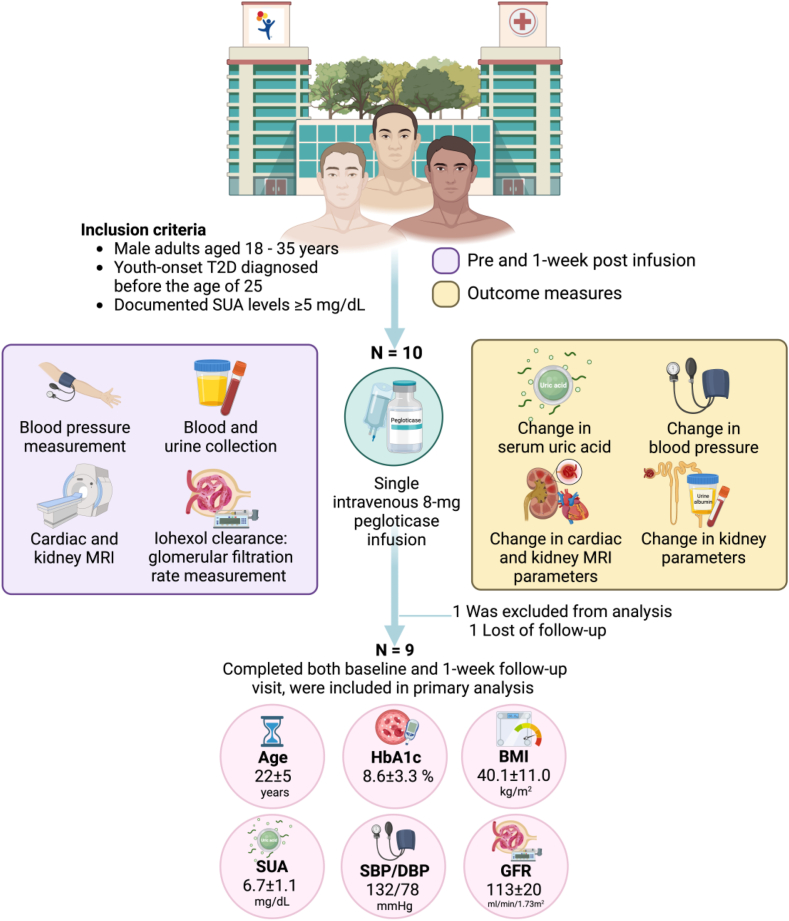
Nine men completed the baseline and one-week follow-up assessments after a single 8-mg infusion. Measurements included cardiac and kidney MRI, aortic 4D flow MRI, blood pressure, and iohexol-based glomerular filtration rate (GFR).
The responses did not all point in the same direction
Median serum uric acid decreased from 6.4 to 0.5 mg/dL. Mean body-surface-area-standardized GFR increased from 113 to 122 mL/min/1.73 m². Meanwhile, the magnitude of peak longitudinal cardiac strain decreased from 15.6% to 13.4%, and mean aortic wall shear stress decreased from 1.5 to 1.4 Pa. Ejection fraction and pulse wave velocity did not show statistically significant changes.
A concerning signal, with an important boundary
The observed cardiac findings moved in a direction that raises concern. Longitudinal strain magnitude decreased, suggesting less myocardial deformation at follow-up. Diastolic blood pressure also rose from 77 to 85 mm Hg, while left ventricular end-diastolic volume increased. These observations deserve attention, rather than an assumption that lowering uric acid necessarily benefited every organ.
However, a concerning direction in measured variables is not the same as demonstrating clinically meaningful deterioration. Strain and ventricular volume can vary with loading conditions as well as myocardial properties. Because blood pressure changed too, this study cannot separate a change in intrinsic contractile function from a response to altered hemodynamics. This is a possible explanation to investigate, not a mechanism established by these data.
It is therefore more accurate to describe a short-term signal compatible with worse longitudinal deformation after infusion than to conclude that pegloticase caused lasting heart damage. The absence of statistically significant changes in ejection fraction or PWV neither cancels the strain finding nor establishes safety. Each measure captures a different aspect of physiology, and the size and persistence of any effect remain uncertain.
What MRI adds to the story
Ejection fraction describes the proportion of ventricular blood volume ejected during contraction. Strain describes myocardial deformation. These measurements answer different questions, so a strain change alongside no statistically significant ejection-fraction change deserves attention without implying a clinical diagnosis.
In this report, longitudinal strain is presented as a positive magnitude. A smaller value therefore means less longitudinal deformation, rather than a more negative strain value. This distinction matters when comparing the result with software or papers that use a signed strain convention.
Flow imaging provides another perspective. Wall shear stress describes the tangential force of flowing blood at the vessel wall, while PWV describes the speed at which a pulse travels along an artery. Neither should be treated as an interchangeable measure of overall cardiovascular health.
A higher GFR is not automatically a long-term benefit
GFR measures filtration, not the full health of the kidney. In diabetes, interpreting an increase requires attention to the starting value, hyperfiltration, and subsequent outcomes. The one-week observation cannot establish that kidney injury was prevented or that a higher filtration rate would persist.
What this pilot can and cannot establish
The small sample, male-only participant group, short follow-up, and absence of a control group limit interpretation and generalizability. Before-and-after differences cannot isolate treatment effects from every other influence, and multiple measured outcomes make replication especially valuable. A nonsignificant result also does not prove that no effect exists.
Statistical significance addresses uncertainty within the analysis; it does not establish the cause of a change or its clinical importance. With a small pilot, estimates may be unstable and chance findings are possible when many outcomes are examined. Even a reproducible MRI change would need to be related to symptoms, functional consequences, or longer-term outcomes before being treated as evidence of clinical harm.
A larger controlled study could test whether these changes recur, whether they persist or recover, and whether their interpretation changes after accounting for blood pressure and loading conditions. Repeated MRI measurements, prespecified outcomes, and longer clinical follow-up would help distinguish a transient physiological response from a clinically important effect.
These data raise a cardiac safety question; they do not settle it. This pilot should encourage careful follow-up of the unfavorable signal without claiming proven cardiac harm. Likewise, the higher GFR should not be presented as established kidney protection. Neither finding alone provides a basis for using pegloticase to prevent diabetes-related complications.
Related research
For a different application of flow MRI in diabetes, read the E/A vorticity ratio in type 2 diabetes. For the vascular measurements, explore PWV reference values and measurement methods and structural and load-dependent arterial stiffness. These posts provide context, rather than independent confirmation of this pilot’s treatment findings.
Original paper
Narongkiatikhun P, Park S, et al. Pegloticase-Induced Rapid Uric Acid Lowering and Kidney and Cardiac Health Markers in Youth-Onset Type 2 Diabetes: A Pilot Clinical Trial. Kidney Medicine. 2024;6(12):100911. Read the open-access paper.
Keywords: pegloticase, uric acid, youth-onset type 2 diabetes, cardiac MRI, kidney MRI, longitudinal strain, GFR, 4D flow MRI.